
Cosmo did not begin as a product plan. It began as a long-running curiosity about robotics, intelligence, interaction, and the feeling that a machine could become more than a tool when its systems are designed to work together.
1999 - 2014
The Early Spark
Since childhood, I dreamed of working with robotics and technology. This is where the idea behind Cosmo began.
2021
Engineering Foundations
I started my Computer Engineering degree and became an active member of BAJA, a student-driven engineering project. I worked as the electromechanics and electronics coordinator, leading a team of Computer Engineering students responsible for telemetry and sensor systems for an off-road vehicle.
2023
From Bimo to a Real Concept
Between 2021 and 2023, I changed my degree to Systems Development, but the idea of Cosmo stayed with me. At that time, I called the project Bimo and started defining what I wanted it to become.
Later, I changed my degree again, this time to Cybersecurity. During that period, I created a personal web server on the dark web that displayed a simple robot cartoon animation. That was my first experience configuring and deploying a Linux server.
I also started a simulation of Bimo using Wokwi as an Arduino-based environment. The simulation included a distance sensor, a display, and a few servos. It showed different facial expressions depending on how close it was to an object.
2024
Graduation Project
Bimo became a graduation project and received the maximum grade.
2026
Cosmo Takes Shape
In the final stage of my graduation, already carrying more programming and architecture knowledge, I decided to start developing the project seriously. My sister kept encouraging me to build it, saying it would be much cooler if I finally made it real.
At that point, I renamed the project from Bimo to Cosmo to make it more original, since Bimo was inspired by BMO from Adventure Time.
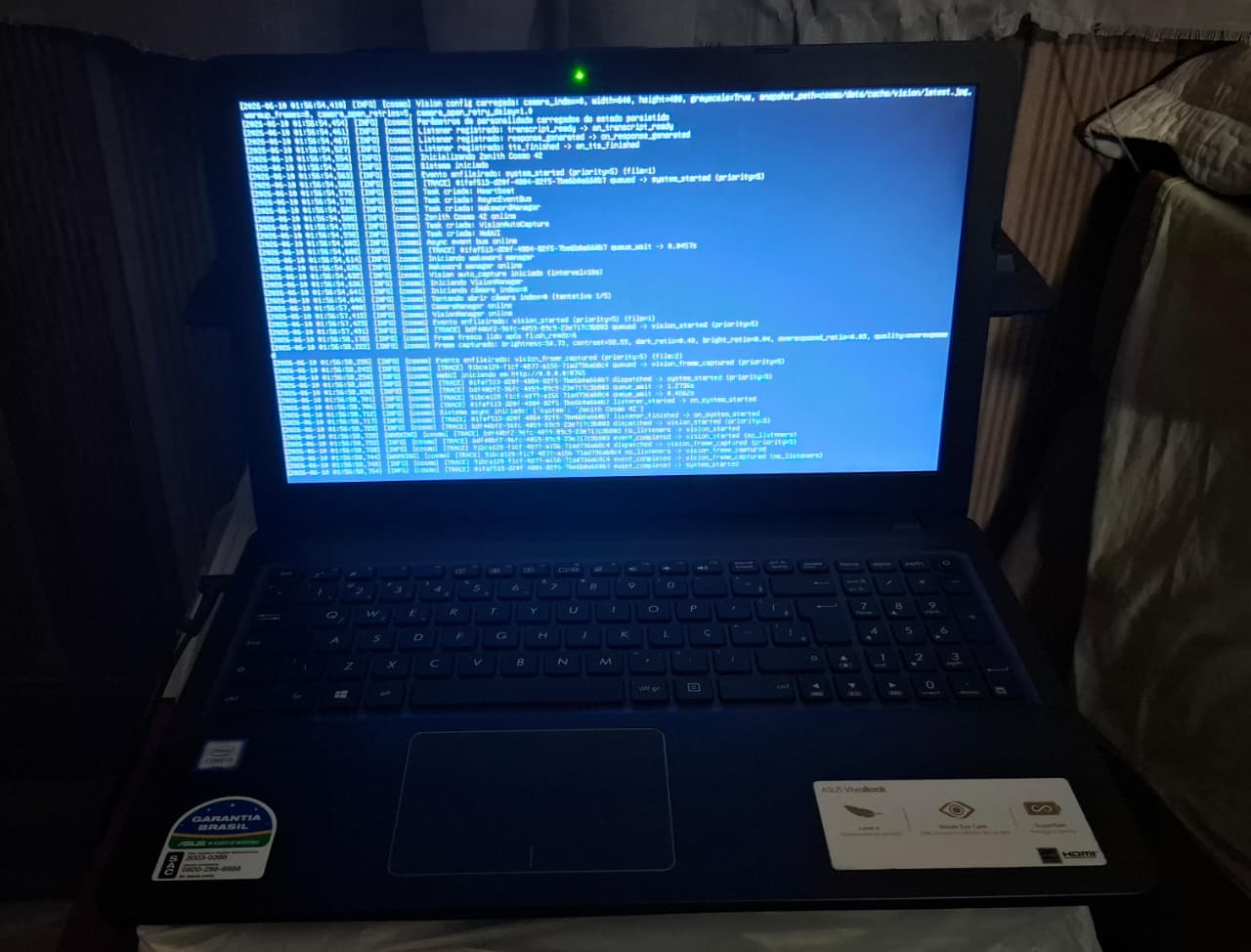
I realized that an old laptop already had more than half of the resources I needed: memory, audio input and output, SSD storage, Wi-Fi, system sensors, and more processing power than an Arduino or other low-cost microcontroller. Later, I would only need an ESP32 to communicate with the main system through HTTP and give Cosmo a robotic body with movement.